Spray & Combustion Simulation

We possess profound theoretical foundations in CFD and extensive experience in advanced OpenFOAM applications, specializing in high-fidelity numerical simulation of atomization droplet dynamics, turbulent combustion, and their strongly coupled processes. This competence is central to supporting cutting-edge engineering in spray cooling, internal combustion engine design, aero-engine combustor optimization, and industrial burner development.

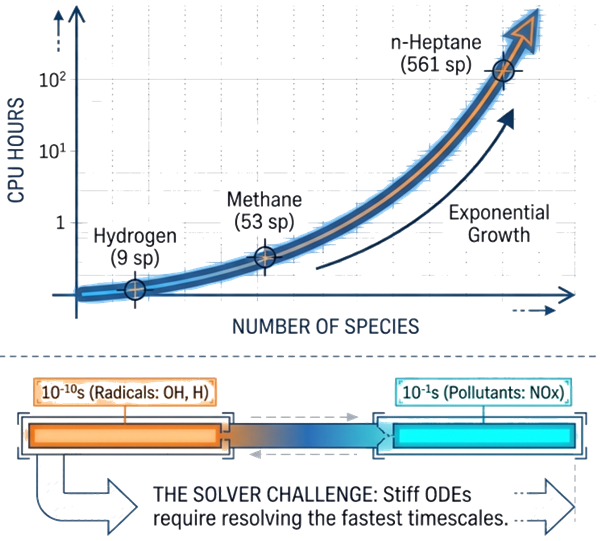
Balancing Fidelity with Feasibility

Direct integration of detailed kinetics is the bottleneck of modern CFD. Simulating a single engine cycle with full chemistry (500+ species) on a 3D grid exceeds current supercomputing capacities.

We simplify intricate chemical kinetics into compact skeletal mechanisms. By removing redundant reactions while preserving the essential thermochemical pathways, we enable rapid simulation without sacrificing the accuracy needed for performance prediction.

  • Sensitivity analysis: Individual link-to-ground contact modeling for authentic traction and climbing.
  • Targeted temperature/pressure range optimization: Detailed torsion bar and shock absorber simulation for high-speed cross-country stability.
  • Validation against detailed mechanisms: Recoil dynamics and turret stabilization integration.
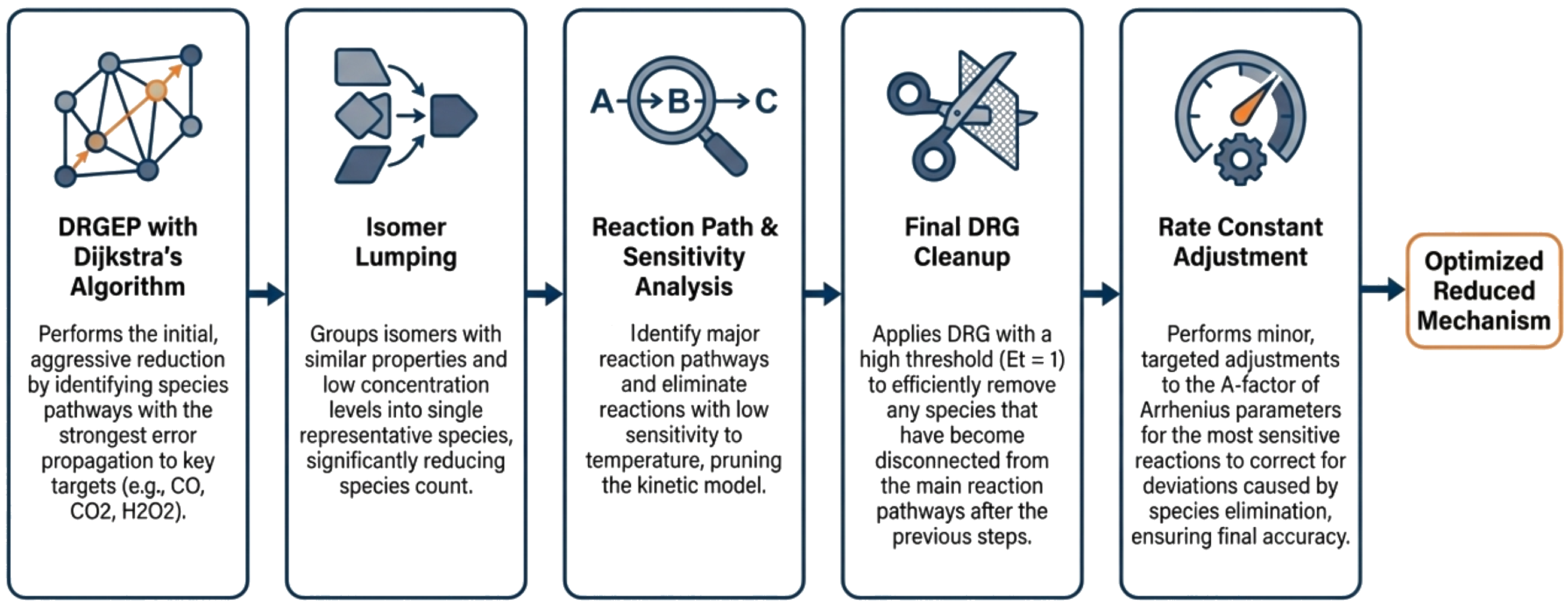
The Innovation: A Multi-Stage, Integrated Reduction Scheme

A new scheme was developed to combine the strengths of multiple techniques in a logical sequence, enabling deeper and more robust reduction.

Refining the Model with Path Analysis


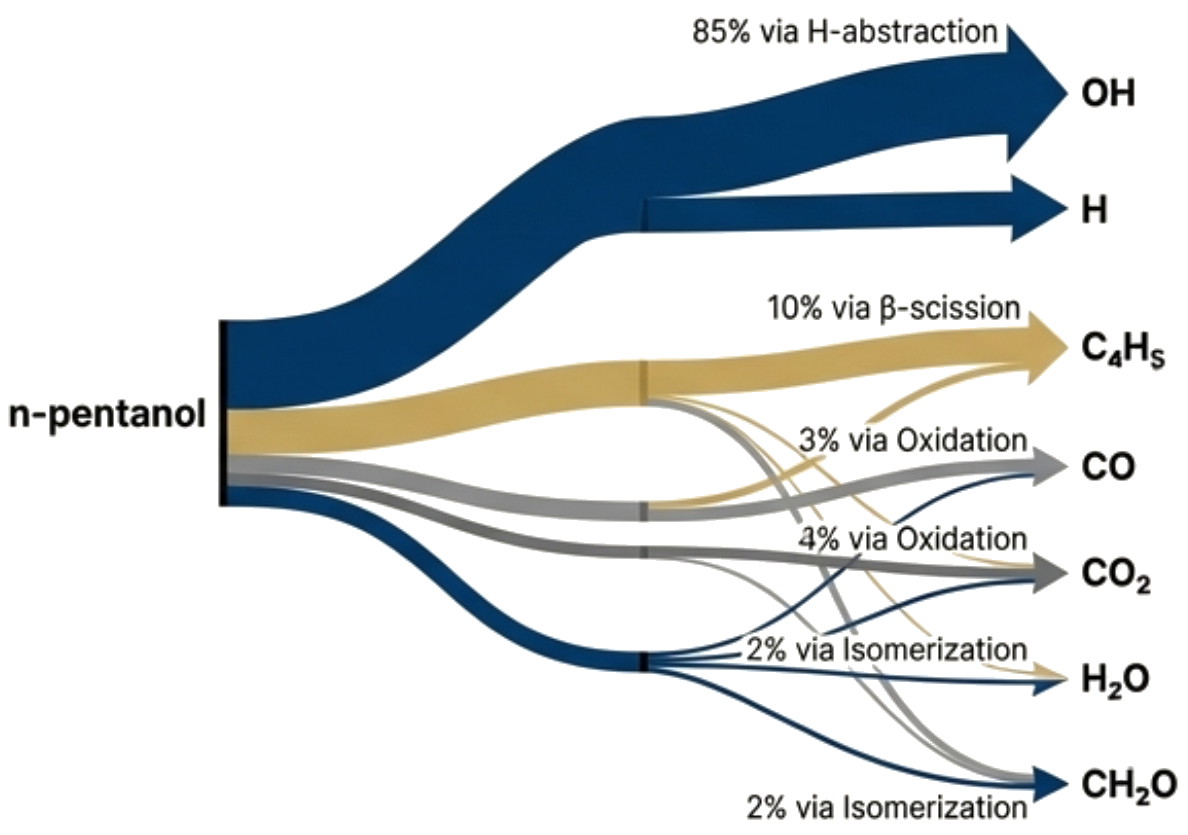
Visualizing Chemical Pathways

Reaction Path Analysis (RPA) is a critical diagnostic tool used to visualize and quantify the dominant chemical pathways. It allows us to identify the ‘skeleton’ of a mechanism, understand transitions between high and low-temperature chemistry, and pinpoint the reactions most critical for energy release and pollutant formation.


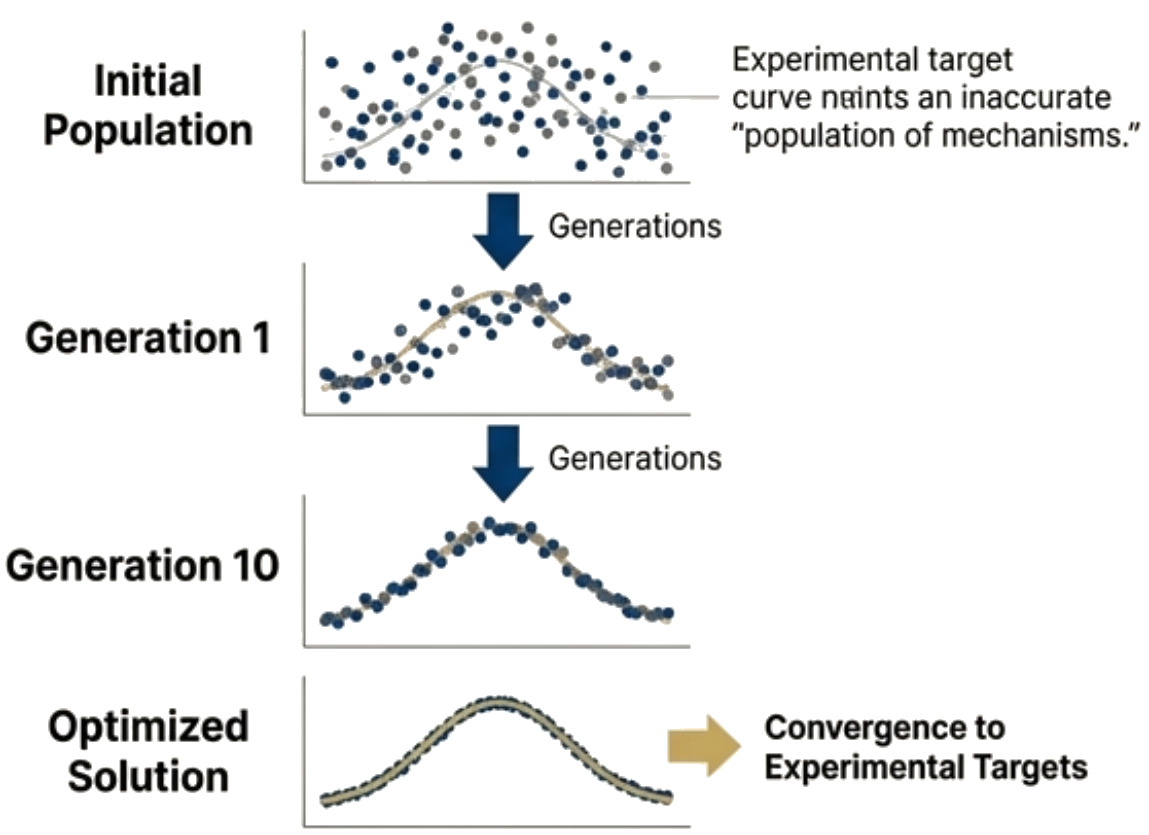
AI-Powered Optimization

Genetic Algorithms (NSGA-II) are used to ‘evolve’ a population of reduced mechanisms, automatically tuning reaction rate constants within their uncertainty limits to simultaneously minimize errors against multiple experimental targets (e.g., ignition delay, flame speed). This achieves higher accuracy without increasing model size.

Automated CRN Construction

CRN decouples detailed chemistry from the complex flow field. By abstracting the 3D domain into a network of ideal reactors (PSR, PFR), we can run thousands of species in seconds while maintaining the physical structure of the combustor.


1. Zonal Clustering

Uses ML (K-Means/PCA) to group CFD cells into thermochemically homogeneous zones.

Criteria:

Temp, Velocity, Phi

2. Network Topology

Determines mass fluxes and connections between reactors using graph-based scanning and PSO optimization.

Physics:

Mass & Energy Balance

3. Emission Mapping

Post-processes the CFD flow with detailed kinetics to predict trace species like NOx and soot.

Speed:

1000* faster than CFD

Our Technical Expertise

  • Multiphase Models: Proficient in VOF, Eulerian-Lagrangian (DPM/parcels) methods, and coupled Level-Set with VoF interface-capturing techniques for high-fidelity atomization simulation.
  • Combustion & Chemical Mechanisms: Extensive experience in constructing, reducing, and validating mechanisms ranging from detailed chemical kinetics to simplified flamelet models (e.g., FGM/FPV) and transported PDF models.
  • HPC & Custom Development: Based on the OpenFOAM open-source framework, we customize solvers, implement models, and optimize for large-scale parallel computing to address specific problems, overcoming the limitations of standard features.
  • Verification & Validation: Strictly adhere to V&V processes, ensuring result reliability through mesh independence studies and comparisons with classical experimental data (e.g., Spray A/B) or high-fidelity simulation results.

Key Physical Processes We Can Simulate

Physical Process

Simulation Capability & Challenge

Primary & Secondary Atomization

Simulate the entire process from liquid sheet formation, primary breakup to secondary atomization, accurately predicting droplet Sauter Mean Diameter (SMD), velocity fields, and spatial distribution.

Core challenge: Capturing gas-liquid interface dynamics and sub-grid scale breakup/coalescence effects.

Turbulent Flame Modeling

Simulate the interaction between turbulence and finite-rate chemical reactions to predict flame structure, stabilization location, combustion efficiency, and pollutant (e.g., soot, NOx) formation.

Core challenge: Accurate modeling and efficient computation of turbulence-chemistry scale coupling.

Spray Combustion Coupling

Simulate real-world complex processes such as fuel spray evaporation, droplet-flame interaction, and non-premixed/partially-premixed combustion. This represents the pinnacle of this competence, requiring deep mastery of integrated solving for multiphase flow, heat/mass transfer, and chemical kinetics.