Engineering Uncertainty Analysis: A Comprehensive Guide

Uncertainty Analysis (UA) is the process of quantifying the potential for error in measurements and modeling. In engineering, it is critical for establishing confidence intervals, ensuring structural reliability, and optimizing robust designs. By moving from a purely deterministic view to a probabilistic framework, engineers can better manage risks and make informed decisions under conditions of limited information.

The Two Faces of Uncertainty: Aleatory vs. Epistemic

UQ methods are distinguished by their ability to handle two fundamental types of uncertainty. Understanding this distinction is key to selecting the right approach.


    1. Aleatory Uncertainty

  • Irreducible variability inherent in nature. It is often referred to as variability, inherent uncertainty, or uncertainty due to chance.
  • Example: “Uncertainty in the toss of a fair die.”
  • Modeling Approach: Typically modeled with probability distributions.


    2. Epistemic Uncertainty

  • Reducible uncertainty resulting from a lack of knowledge or information. An increase in knowledge will lead to a reduction in this uncertainty.
  • Example: “Uncertainty about whether the die is fair.”
  • Modeling Approach: Often modeled with non-probabilistic methods like intervals or evidence theory.

A Map of the UQ Landscape: Four Core Strategies

While dozens of specific algorithms exist, most forward UQ methods all into one of four major families, each with distinct trade-offs between computational cost, accuracy, and the type of problem they are best suited to solve.

Sampling Icon

1. Direct Sampling

The Brute-Force Gold Standard

Reliability Icon

2. Reliability Analysis

The Search for Rare Events

Surrogate Icon

3. Surrogate Modeling

The Smart Approximation

Bayesian Icon

4. Bayesian Inference

The Inverse Problem (Learning from Data)

Category 1: Direct Sampling — The Brute-Force Gold Standard

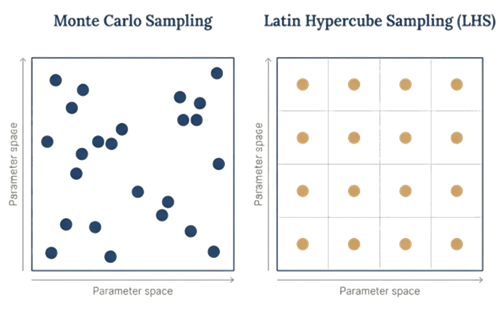
The most straightforward approach is to generate thousands of input parameter sets according to their probability distributions and run the model for each set.

  • Key Methods: Monte Carlo (random sampling) and Latin Hypercube Sampling (LHS), a stratified technique where the range of each variable is divided into segments of equal probability.
  • Pros: Robust, model-agnostic, and conceptually simple. LHS requires fewer samples than Monte Carlo for the same accuracy in statistics.
  • Cons: Can be prohibitively expensive for complex models, especially when resolving low-probability events.

Category 2: Reliability Analysis — The Search for Rare Events

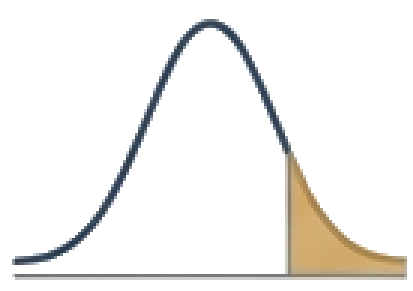
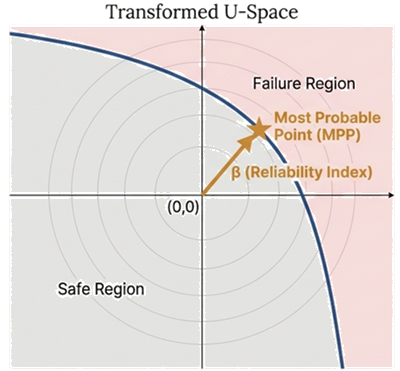
These methods are designed to efficiently compute statistics in the tails of response distributions. Instead of sampling the entire space, they focus on finding the Most Probable Point (MPP) of failure.

  • Core Concept: The MPP is the point on the failure surface with the minimum distance to the origin in a transformed space of standard normal variables. This makes the probability calculation more tractable.
  • Key Methods: First-Order and Second-Order Reliability Methods (FORM/SORM), Advanced Mean Value (AMV).
  • Best For: Problems where you need to find the probability of low-probability, high-consequence outcomes without the massive cost of Monte Carlo.

Category 3: Surrogate Modeling — The Smart Approximation

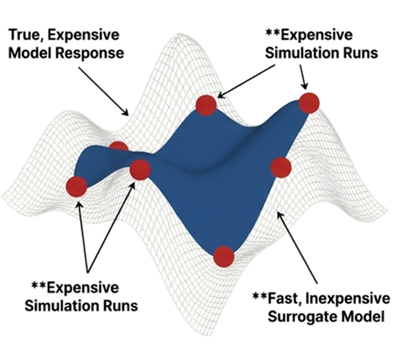
When a single model run is expensive, the goal is to build a cheap, fast statistical model (a “surrogate” or “emulator”) that accurately predicts the output of the expensive simulation. This surrogate can then be sampled tens of thousands of times at virtually no cost.

  • Polynomial Chaos Expansions (PCE): Approximates the model response with a basis of multivariate orthogonal polynomials.
  • Kriging (Gaussian Process Modeling): A statistical interpolation method that provides not just a prediction but also an estimate of the prediction variance.
  • Advanced Hybrids: Techniques like PC-Kriging combine the strengths of both PCE and Kriging.

Category 4: Bayesian Inference – Learning Model Parameters from Data

This approach addresses the inverse problem: given experimental data, what are the most plausible values for our uncertain model parameters? Bayesian methods use data to update our beliefs about these parameters.

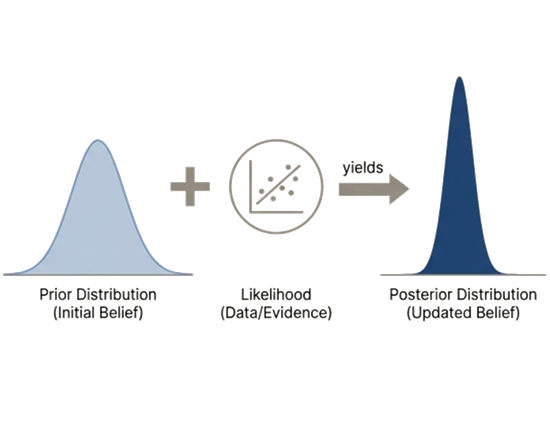
  • Core Concept: A prior probability distribution (our initial belief about a parameter) is combined with a likelihood function (how well the model predictions match the data) to produce a posterior distribution (our updated, refined belief).
  • Workhorse Algorithm: Markov Chain Monte Carlo (MCMC) is the primary method used to explore the parameter space and estimate the posterior distribution.

UQ in Action: Predicting Performance and Failure in Critical Systems

The methods and tools discussed are not just academic; they are being applied to solve challenging engineering problems where reliability is paramount. UQ provides the confidence needed for principled decision-making.


  • Predicting the life of lithium-ion batteries at an early stage.
  • Enables better battery management systems, design improvements, and safety assessments.


  • Predicting the remaining useful life (RUL) of turbofan engines.
  • Facilitates predictive maintenance, improves operational safety, and reduces costs.

Industry Solutions

Harness our IT strategy consulting across key business domains to automate workflows, refine customer service, and increase overall productivity.

Aerospace

Aerospace & Defense

Aerospace structures operate in dynamic environments where safety-critical boundaries—such as flutter margin—are sensitive to variations in geometry, material properties, and conditions. Our uncertainty quantification (UQ) solutions provide the probabilistic evidence needed for certification and optimized design, enabling risk-informed engineering beyond conservative safety factors. By integrating flight test data and high-fidelity simulations, our UQ framework validates structural integrity across the entire flight envelope while accounting for manufacturing and operational variability.

Automotive

Automotive & EV

The shift toward autonomy and electrification is moving automotive engineering from deterministic safety factors to probabilistic reliability. Our UQ suite quantifies simulation noise, predicts battery health under variable loads, and ensures NVH comfort by accounting for manufacturing tolerances at scale. This enables automakers to confidently certify autonomous systems and electric powertrains with demonstrable reliability metrics rather than traditional safety margins.

Energy

Energy & Infrastructure

Facing uncertainty from environmental variability, aging assets, and extreme events, our UQ framework delivers the rigorous evidence needed to extend wind fleet lifespans, ensure seismic safety, and manage subsurface reservoir risks—shifting from conservative estimates to data-driven risk management. Regulatory bodies and stakeholders gain transparent, quantified confidence in infrastructure performance under both normal operations and rare hazard conditions.

Manufacturing

Manufacturing

Our UQ suite connects design with production reality by quantifying the cumulative effects of tolerances, tool wear, and sensor noise—enabling "first-time-right" production. Inspired by robust methods like Nodes, we shift manufacturing from reactive quality control to proactive reliability science. Manufacturers can predict yield rates, optimize process parameters, and reduce waste before a single part is produced.