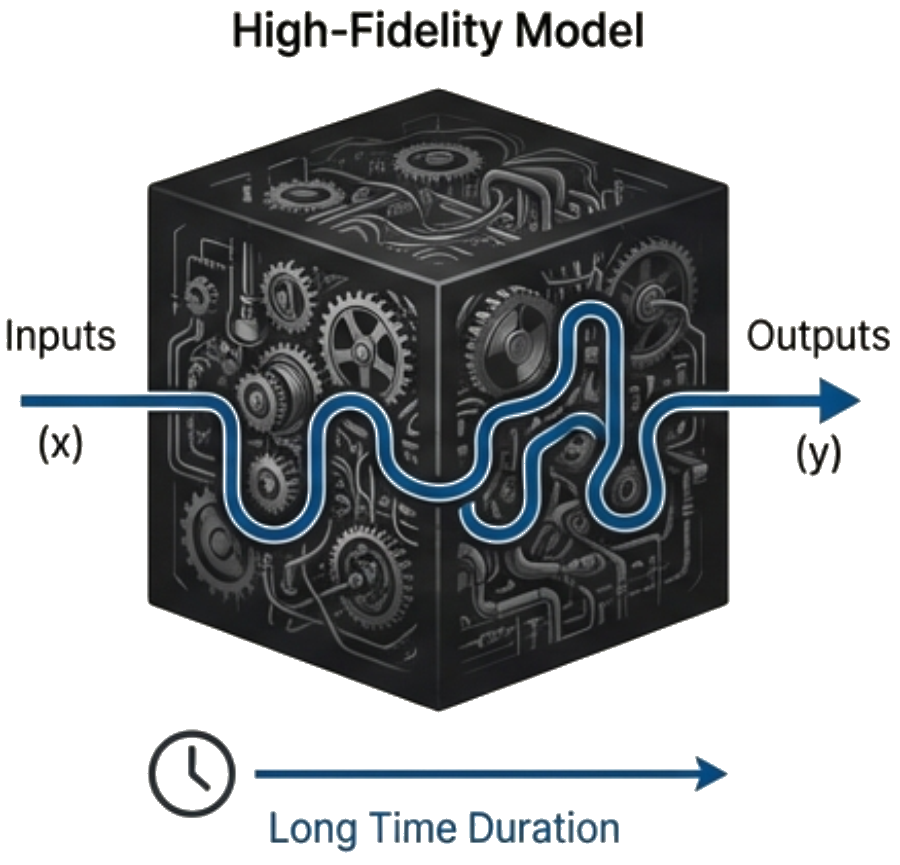
Surrogate Modeling: The Efficient Engine Driving Engineering Innovation
Our Surrogate Modeling solutions are dedicated to significantly reducing the computational cost of high-fidelity simulations for complex engineering systems without sacrificing accuracy. By constructing lightweight, approximate mathematical models, we accelerate Multi-Disciplinary Optimization (MDO), uncertainty analysis, and performance evaluation, providing revolutionary efficiency improvements for your product development.
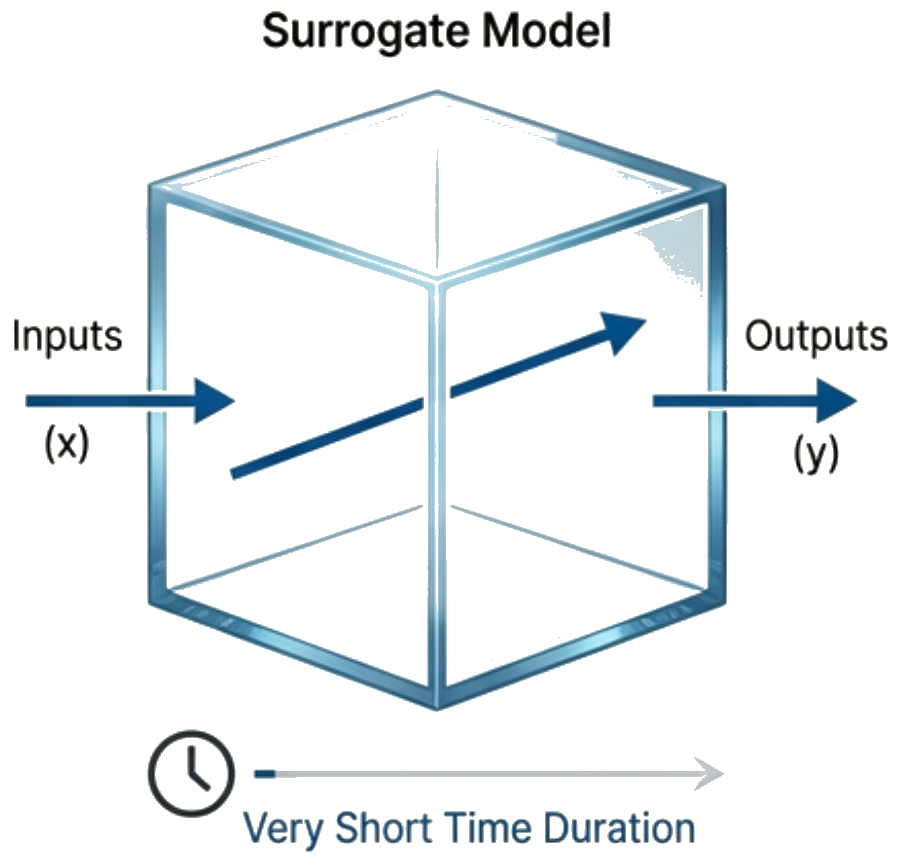
Surrogate Models: A Cheaper, Faster Proxy for Reality
How It Works:
The inner working of the simulation are treated as a "black box". The surrogate is constructed by modeling the response of the simulator to a limited number of intelligently chosen data points.
- Polynomial Response Surface
- Kriging (Gaussian Process Regression)
- Radial Basis Functions (RBF)
- Artifical Neural Networks (ANN)
- Support Vector Machines (SVM)
- Polynomial Chaos Expansions (PCE)
Common Methodologies
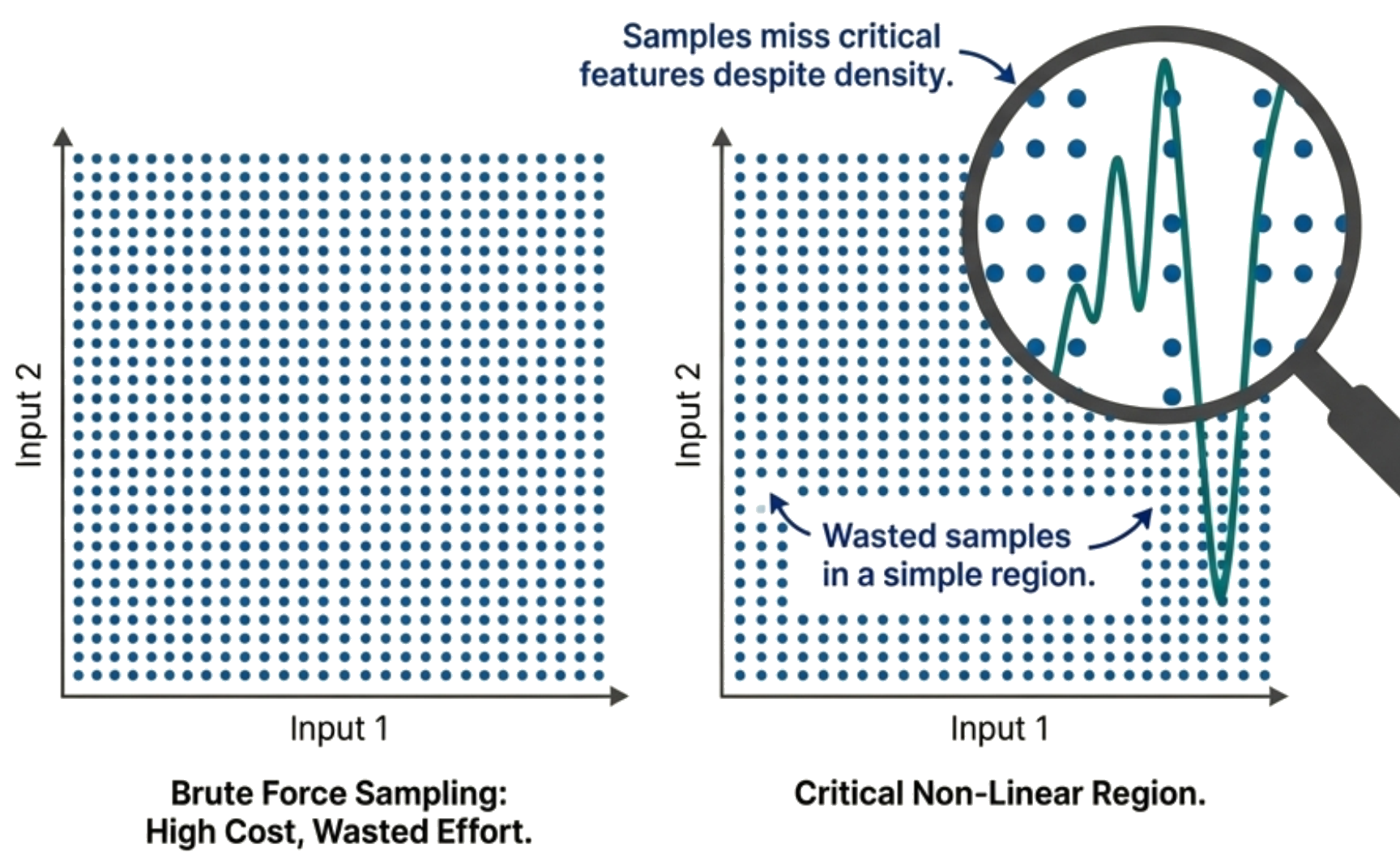
The Sampling Dilemma: Surrogate Accuracy Depends Entirely on Training Data
Traditional phenomenological (e.g., Johnson-Cook) and microstructural models rely on predefined mathematical functions. This introduces 'model error' and struggles with complex nonlinear behaviors. Obtaining parameters is expensive and time-consuming (e.g., Split Hopkinson Pressure Bar tests).
- Artificial Neural Networks (ANNs) learn constitutive relationships directly from experimental or simulation data, without needing explicit mathematical expressions (acting as a 'black box').
- This approach avoids errors from predefined functions, handles uneven data, and can uncover previously unknown constitutive laws.
- Example: The FE-PDNN (Finite Element-Positive Definite Deep Neural Network) system learns nonlinear relationships for composite materials and can be integrated directly into commercial software like Abaqus.
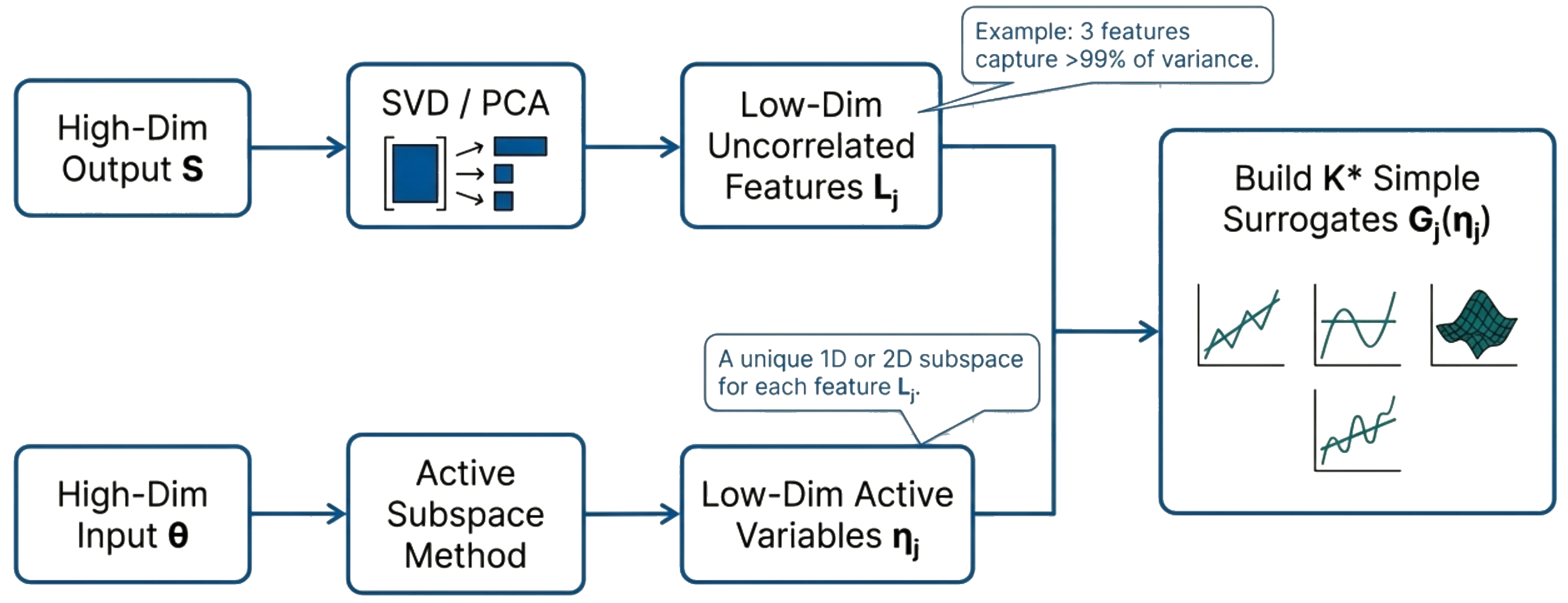
A Unified Strategy for High-Dimensional Problems
Many modern engineering systems have both a large number of inputs and high-dimensional outputs. Surrogates suffer from the "curse of dimensionality" in these scenarios.
We address high dimensionality by systematically reducing the dimensions of both the output and input spaces before building the surrogate.
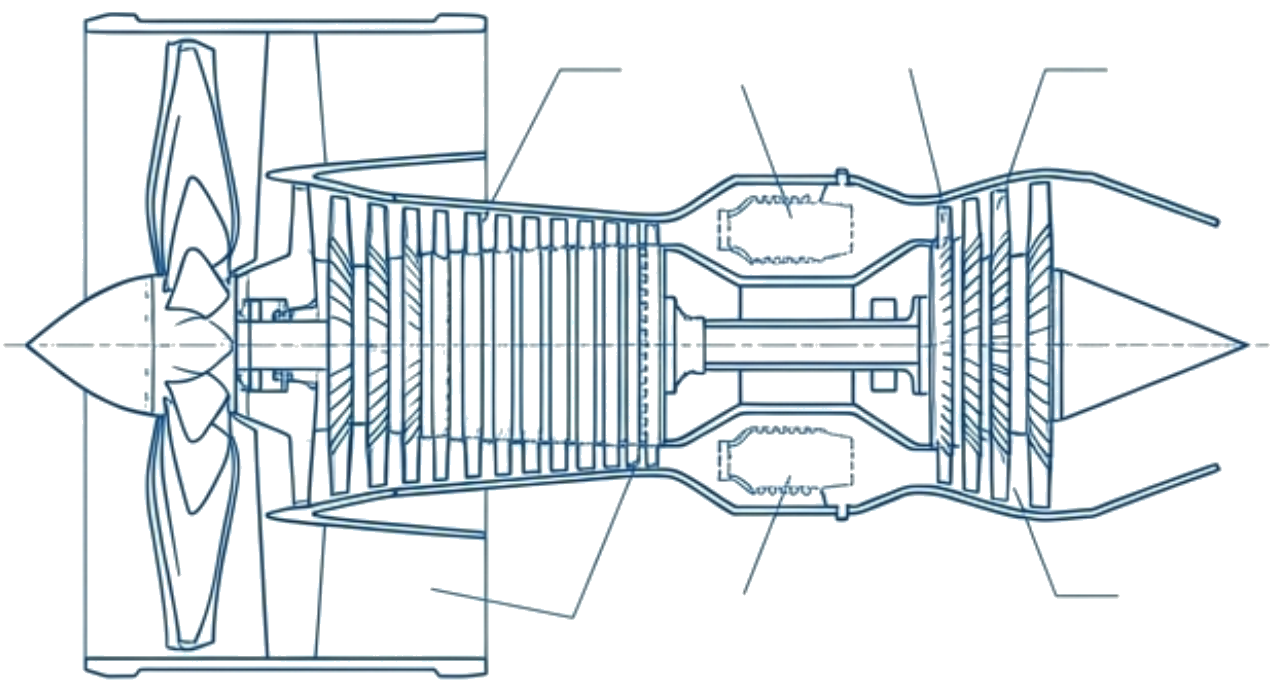
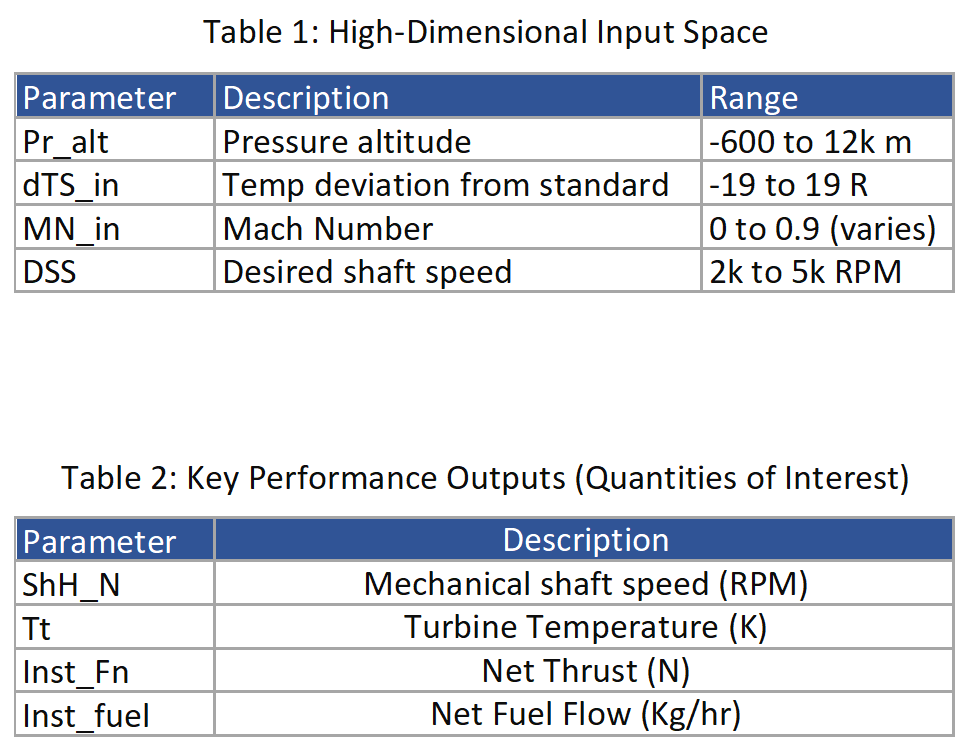
Case Study: Building a High-Accuracy Surrogate for a Turbofan Jet Engine
- Objective: Create a surrogate model of a functional areo-thermal performance model of a two-spool turbofan system with extremely high accuacy (<0.1% relative error).
- The model: The reference physics-based model was built using PROOSIS (Propulsion Object Oriented Simulation Software). The surrogate is a "Digital Echo" from JuliaSim.
Key Service Modules
Our analysis covers the full lifecycle from data acquisition to decision support, significantly reducing R&D costs and time-to-market.
-

灵敏度分析 | Sensitivity Analysis
A systematic approach to identify which input parameters have the most significant impact on model performance. This helps prioritize resources and focuses attention on the critical factors that truly drive outcomes.
-

设计空间探索 | Design Space Exploration
A computational approach that systematically evaluates thousands of design variants to identify optimal solutions. This method enables engineers to navigate complex design landscapes, uncovering innovative configurations that might be missed by traditional trial-and-error processes.
-


多目标优化 | Multi-objective Optimization
A technique that balances conflicting goals such as minimizing weight while maximizing strength. It generates a set of optimal trade-off solutions, allowing decision-makers to select the best compromise based on project priorities.
-


不确定性量化 | Uncertainty Quantification
A process that assesses how manufacturing variations and environmental noise impact system performance. This helps engineers build more robust designs by understanding and mitigating the effects of real-world uncertainties.
